
Your business may need on-site security guards when existing security measures cannot adequately manage unauthorised access, protect employees, prevent recurring incidents or provide an immediate physical response to security concerns. Businesses with valuable assets, multiple entrances, extended operating hours or regular visitor traffic may particularly benefit from professional manned guarding services.
According to the UK Home Office's 2023 Commercial Victimisation Survey, 26% of business premises in England and Wales experienced at least one of the crimes covered by the survey during the previous 12 months.
However, this does not mean every business needs permanent guarding. A small office with controlled access and monitored CCTV has different requirements from a warehouse operating around the clock.
At ZAM FM, we recognise that effective security begins with understanding the people, premises and operations that need protecting.
This guide explains when on-site security becomes necessary, what research tells us about its effectiveness and how businesses can choose the right level of protection.
What Do On-Site Security Guards Actually Do?
On-site security guards help protect business premises by controlling access, monitoring activity, conducting patrols, supporting staff and responding appropriately to security incidents.
Unlike CCTV systems that primarily monitor and record activity, trained officers provide a physical presence and can take appropriate action when human intervention is required.
Their responsibilities may include:
- Checking visitor, employee and contractor authorisation.
- Monitoring entrances, exits and restricted areas.
- Conducting scheduled security patrols.
- Reporting suspicious activity and security concerns.
- Supporting opening and closing procedures.
- Following established emergency-response protocols.
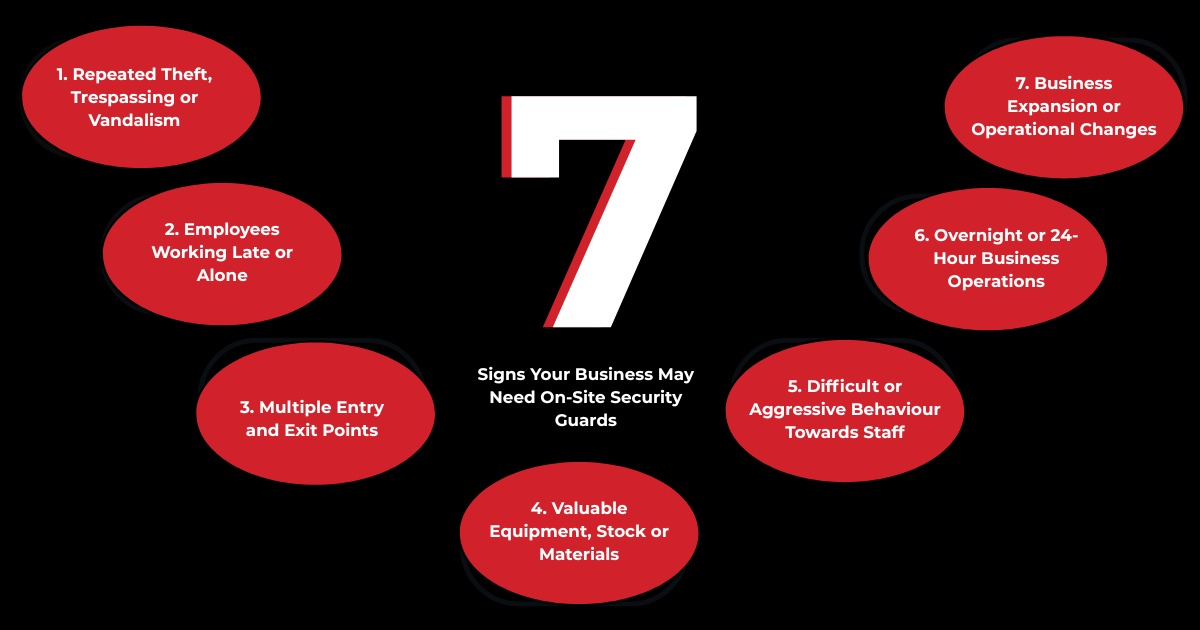
7 Signs Your Business May Need On-Site Security Guards
Repeated incidents, inadequate access control, lone working, valuable assets, difficult visitor interactions, overnight operations and business expansion are common reasons to reassess on-site guarding requirements.
1. Repeated Theft, Trespassing or Vandalism
Businesses experiencing recurring security incidents may benefit from on-site guards when existing measures are not adequately preventing or managing those incidents.
For instance, CCTV might record unauthorised access, but without appropriate response arrangements, suspicious activity may go unaddressed.
Security guards can conduct patrols, monitor vulnerable locations and follow established incident procedures.
However, guarding should complement effective locks, fencing, lighting and access-control systems rather than replace them.
2. Employees Working Late or Alone
On-site security may be appropriate when employees work in isolated areas or outside normal hours and require additional assistance identified through a risk assessment.
Consider an employee closing a commercial building after colleagues have left. The business should establish how that employee can obtain help if an unexpected incident occurs.
Security personnel may support closing procedures, monitor access and provide an additional point of contact.
Employers must still follow appropriate lone-working risk management and employee-safety procedures.
3. Multiple Entry and Exit Points
Businesses with several entrances, delivery bays or vehicle access points may require security guards when these areas cannot be adequately supervised through existing arrangements.
Warehouses, industrial facilities and large commercial properties often receive visitors, employees, contractors and delivery drivers throughout the day.
Security guards can check authorisation, monitor entry points and help prevent unauthorised access to restricted areas.
The necessary staffing level depends on the site's layout and operational requirements.
4. Valuable Equipment, Stock or Materials
On-site guarding may be suitable when theft or damage involving valuable assets could cause significant financial loss or interrupt essential operations.
Construction sites, warehouses and industrial facilities may store machinery, equipment or large quantities of stock.
Security officers can support access control, monitor vulnerable areas and carry out agreed checks.
Businesses should also consider whether CCTV, secure storage and mobile patrols can adequately address the risks.
5. Difficult or Aggressive Behaviour Towards Staff
Security personnel may be beneficial when businesses experience threatening behaviour, unauthorised visitor disputes or situations requiring trained de-escalation support.
This concern is supported by UK workplace research.
The Health and Safety Executive's 2024/25 statistics estimate that 689,000 incidents of workplace violence, including assaults and threats, occurred among working adults in England and Wales. Around 329,000 working adults experienced at least one such incident.
These figures cover workplaces across different industries, not only commercial premises requiring security guards.
They demonstrate why employee protection deserves attention in business risk assessments.
Security officers can support staff by managing access, communicating procedures and following appropriate incident-response protocols.
6. Overnight or 24-Hour Business Operations
Businesses operating overnight may need guards when access control, security checks or incident response require somebody to remain physically present.
A distribution centre receiving deliveries throughout the night may need officers to verify vehicles and monitor loading areas.
An office building that becomes vacant after closing may instead be adequately protected through monitored CCTV, keyholding and alarm response.
The decision should reflect the risks associated with specific operating hours.
7. Business Expansion or Operational Changes
Growing businesses should review their security when increased staffing, new premises, longer operating hours or higher visitor numbers create additional responsibilities.
For example, an office that previously accommodated a small team may begin receiving regular contractors and external visitors.
Its existing access arrangements may no longer be suitable.
Reassessing security during expansion can help businesses identify vulnerabilities before they lead to operational problems.
Do Security Guards Actually Reduce Crime?
Peer-reviewed research suggests that targeted security patrols can help reduce certain crimes, although effectiveness depends on the location, deployment strategy and risks involved.
A study published in the academic journal PLOS ONE in 2017 examined the effectiveness of private security patrols at railway stations in South West England.
Researchers from the University of Cambridge and RAND Europe, alongside a collaborator from the Hebrew University of Jerusalem, conducted a six-month randomised controlled trial involving uniformed security personnel.
The study reported that increased security patrol activity was associated with approximately 16% fewer victim-reported crimes across the participating station complexes, alongside a 49% increase in police-generated crime detections at targeted locations.
These results relate specifically to the railway-station experiment. They do not establish that every commercial business will experience the same reduction after hiring security guards.
Nevertheless, the research provides useful evidence for considering visible, targeted patrols as part of a wider security strategy.
Research source: Ariel, B., Bland, M. and Sutherland, A. (2017), ‘Lowering the threshold of effective deterrence’ Testing the effect of private security agents in public spaces on crime: A randomized controlled trial in a mass transit system. PLOS ONE.
Can CCTV Replace On-Site Security Guards?
CCTV can replace some monitoring duties when suitable surveillance and response arrangements are in place, but it cannot fully replace the physical access management, communication and on-site support provided by security officers.
Both solutions have different strengths.
| Security requirement | On-site guards | CCTV |
| Physical presence | Yes | No |
| Visitor management | Direct interaction | Visual monitoring support |
| Security monitoring | Patrols and observation | Camera surveillance |
| Physical inspections | Yes | No |
| Incident response | On-site action within assigned duties | Remote alert and escalation |
| Continuous monitoring | Requires staffing | Possible with suitable systems |
What Does Academic Research Say About CCTV and Security Personnel?
Research indicates that the way CCTV is monitored and operated can influence its crime-prevention effectiveness.
A systematic review published in the Journal of Contemporary Criminal Justice in 2020 examined 165 CCTV evaluations.
The researchers found that CCTV schemes operated by private security personnel produced larger crime-prevention effects than schemes operated by police or mixed police-and-security teams.
This does not prove that simply combining guards with cameras will always produce better results. It highlights the importance of effective monitoring and operational arrangements.
For businesses, the practical lesson is to ensure surveillance systems are supported by clear procedures and appropriate personnel.
Research source: Welsh, B. C., Piza, E. L., Thomas, A. L. and Farrington, D. P. (2020), Private Security and Closed-Circuit Television (CCTV) Surveillance: A Systematic Review of Function and Performance.
ZAM FM offers both security guarding and CCTV surveillance solutions, enabling businesses to consider different protection options.
Which Types of Businesses Benefit Most From On-Site Security?
Warehouses, construction sites, retail premises, corporate offices and industrial facilities may benefit from guarding where their activities require physical security support.
Requirements vary by environment.
Warehouses and logistics facilities: Guards can assist with vehicle access, deliveries, stock protection and monitoring loading areas.
Construction sites: Security officers can support perimeter checks, access management and protection of machinery and materials.
Corporate offices: Guards can manage visitors, monitor restricted areas and support workplace security procedures.
Retail premises: Security personnel may help address recurring theft concerns, manage access and support staff during difficult interactions.
The British Retail Consortium's 2026 Crime Report estimated approximately 1,600 incidents of violence and abuse against retail workers per day during its 2024–25 reporting period. Although this represented an improvement on the previous period, it demonstrates the importance of assessing risks affecting customer-facing employees.
Vacant commercial buildings: Temporary guarding may be suitable where alarms, surveillance and periodic inspections cannot adequately manage the risk of unauthorised access or damage.
The most suitable arrangement depends on each property's circumstances, not simply its industry.
How Much Do Business Security Guards Cost in the UK?
The cost of commercial security guarding depends on staffing levels, working hours, location, site complexity, officer duties and the supervision required.
A business needing security during selected evening hours will have different costs from an industrial facility requiring continuous guarding.
When comparing quotations, businesses should consider:
- Number of officers and working hours.
- Access-control and patrol responsibilities.
- Supervision and incident-reporting arrangements.
- Replacement cover and emergency procedures.
- Opportunities to combine guarding with CCTV or mobile patrols.
The lowest hourly price does not necessarily represent the most suitable service.
A tailored assessment can help establish whether continuous guarding, selected-hour cover or another security arrangement is appropriate.
How Can You Assess Whether Your Business Needs Security Guards?
Assess your need for guarding by reviewing site access, employee safety, asset protection, operating hours, incident history and existing response arrangements.
Use this checklist:
- Have we experienced repeated theft, trespassing or vandalism?
- Do employees regularly work alone or late?
- Are multiple access points difficult to supervise?
- Do we store valuable or business-critical assets?
- Have employees experienced threatening behaviour?
- Does our site require an immediate physical response?
- Are CCTV systems and alarms adequately monitored?
- Do we have clear security incident-response procedures?
- Have operational changes created new vulnerabilities?
If you identify significant unresolved risks, a professional security assessment may be appropriate.
There is no universal number of checked boxes that automatically makes guarding necessary.
The severity of risks, effectiveness of existing controls and consequences of an incident matter more than the number of concerns identified.
What Should You Look for in a Security Guarding Company?
A reliable security provider should offer appropriately SIA-licensed personnel, relevant industry experience, clear reporting procedures and security services tailored to your premises.
In the UK, individuals carrying out licensable contracted guarding activities generally require the appropriate Security Industry Authority licence.
Businesses should also ask about supervision, incident escalation, officer training, replacement staffing arrangements and familiarity with their operating environment.
A suitable provider should explain why particular security arrangements are recommended instead of automatically suggesting permanent coverage.
How Can ZAM FM Support Your Business Security?
ZAM FM provides professional security guarding and complementary services to help businesses protect their premises, employees and day-to-day operations.
Our services include manned guarding, CCTV surveillance, mobile patrols, keyholding and alarm response.
Whether your business operates a commercial office, construction site, warehouse or industrial facility, security arrangements should reflect the risks and responsibilities associated with your premises.
At ZAM FM, we believe effective security is about more than protecting property. It is about providing practical support and helping businesses maintain confidence in their everyday operations.
Final Thoughts: When Should Your Business Invest in On-Site Security?
Your business should consider on-site guards when a physical security presence is necessary and proportionate to address risks that existing systems and procedures cannot adequately manage.
Academic research and official UK statistics reinforce the importance of understanding security risks, but they do not suggest that every business needs the same level of protection.
For some premises, permanent guarding will be appropriate. For others, monitored CCTV, mobile patrols or selected-hour security may be sufficient.
At ZAM FM, we believe security should be built around the people and operations it protects.
Not every business needs a security guard at its entrance. But every business needs a security plan it can depend on.
Request a Tailored Security Assessment
Not sure whether your premises require on-site security guards, CCTV monitoring or a combination of services?
Contact ZAM FM to discuss your business security requirements.
Frequently Asked Questions
Do Small Businesses Need Security Guards?
Small businesses may need security guards when existing measures cannot adequately protect people, premises or important assets. However, many smaller businesses can manage their risks through access control, CCTV and appropriate response arrangements.
Are Security Guards Better Than CCTV?
Security guards provide physical presence and human interaction, while CCTV provides surveillance and recorded evidence. The right choice depends on whether the business needs monitoring, on-site intervention or both.
Can Businesses Hire Security Guards Temporarily?
Yes. Temporary guarding may be suitable for construction projects, vacant commercial buildings, seasonal activities and short-term changes in security requirements.
Are Security Guards Legally Required for Every UK Business?
No. There is no general legal requirement for every UK business to employ on-site security guards. Businesses should assess their risks and comply with any relevant sector-specific obligations and security licensing requirements.
to your premises, operating hours and operational needs.